

18 colours · 1 range
Solid timber flooring
One piece of Australian hardwood, laid and then sanded and coated in your home. It’s the floor you can refinish again and again over decades.
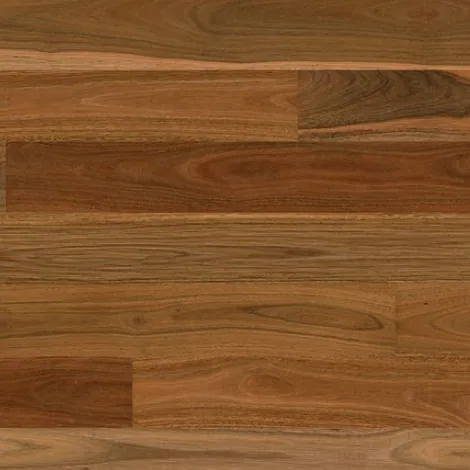
Species we can supply
| Species | Hardness (Janka, kN) | Colour |
|---|---|---|
| Grey Ironbark | about 14–16 | Light grey to light chocolate, with the odd red or black streak |
| Red Ironbark | about 12–13 | Deep red to red-brown |
| Spotted Gum | about 10–11 | Light brown to dark red-brown; can be mottled or streaky |
| Brushbox | about 9–9.5 | Greyish pink to reddish brown |
| Blackbutt | about 9 | Golden yellow to pale brown |
| Tallowwood | about 8.6 | Pale to dark yellow-brown, sometimes an olive tinge |
| Jarrah | about 8.5 | Rich reds to browns |
| Sydney Blue Gum | about 8–9 | Dark pink to reddish brown |
Hardness varies within a species, so treat these as a guide. For comparison, European oak is about 5–7 kN.
What solid timber is
Solid flooring is one piece of sawn hardwood all the way through, usually tongue and groove. In Sydney it’s mostly sold as 19mm boards, 80–85mm or 130mm wide, in random lengths. The 19mm board is structural: it’s nailed to joists or battens.
Most solid timber is supplied raw. We lay it, then sand it flat and coat it on site, so the finish is made in your room. A 14mm overlay version goes over a concrete slab or an existing floor. Prefinished solid exists but is less common.
Grades (Australian Standard AS 2796) describe how much natural feature shows, such as gum vein and knots: Select, Standard (medium feature) and High Feature. It’s a visual grade, not a strength rating.
Is it right for your home?
It suits you if
- You’re in a house on joists, especially a period home with a timber subfloor.
- You plan to stay a long time and want a floor that can be sanded back many times.
- You want an Australian species like Spotted Gum, Blackbutt or Ironbark.
- You’d like the finish, sheen and stain decided in your own light.
Think twice if
- You’re in an apartment. Solid is the hardest floor to make quiet enough for strata.
- You have underfloor heating. Solid timber over heating is generally advised against.
- You need it done quickly. Laying, sanding and coating a new floor takes one to two weeks, and you’ll be out of those rooms for days after.
- You don’t want any seasonal movement. Solid boards open small gaps in dry months. That’s normal.
Solid vs engineered
| Solid timber | Engineered | |
|---|---|---|
| Construction | Hardwood all the way through | Hardwood top layer on a plywood core |
| Sanding | Several times over its life | Depends on top layer; some manufacturers don’t allow it |
| Movement | More: gaps in winter, swelling in humid months | Less |
| Over a slab | Needs plywood or battens, or a 14mm overlay | Straight onto the slab |
| Finish | Usually made on site | Factory finished |
| Species | Mostly Australian hardwoods | Mostly European oak |
| Time to finish | One to two weeks, plus curing | Often a few days |
Where it can go
Generally not recommended
Underfloor heating
Solid boards move too much with heat. If you have heating, look at engineered ranges that allow it.
Hard to get approved
Apartments
Making solid timber quiet enough usually means plywood glued to an acoustic underlay, then the timber. Strata will want a test report for that exact build.
Choose a harder species
Pets
Spotted Gum and Ironbark resist claws and dents far better than oak. Nothing stops stilettos.
Yes, with care
Kitchens
Wipe spills quickly and use mats at the sink.
No
Bathrooms and laundries
Solid timber swells and shrinks with moisture.
What changes the price
- Species and grade: harder and rarer species, and Select grade, cost more.
- Board width: wider boards cost more and need more care with fixing.
- Your subfloor: joists in good order are simplest; a slab needs plywood or battens.
- The coating system: water-based, solvent 2-pack or oil, and the number of coats.
- Removal: taking up carpet, tiles or old boards, and disposal.
- Stairs, nosings and trims.
Already have timber floors? Sanding and polishing may be all you need.
Solid timber questions
What’s the hardest timber?
Of the common Australian species, Grey Ironbark, at about 14–16 kN on the Janka scale. Red Ironbark and Spotted Gum are also hard. Even very hard timber can be marked by stilettos.
How many times can solid floorboards be sanded?
A 19mm floor allows several resands over its life, up to about five as a rough guide. It depends on how much timber is left above the tongue, so we check that on site before quoting.
My boards gap in winter. Is that normal?
Some seasonal gapping is normal in solid timber: boards shrink in dry months and close up again when it’s humid. Large or growing gaps aren’t normal and should be inspected.
How long does a new solid floor take?
About one to one and a half weeks for 50 m², and about two weeks for 100 m², because it’s laid, then sanded and coated on site. We confirm the timing after the measure.
Do we need to move out?
The rooms must be empty. Water-based coatings need about 3 days before you move back in; natural and hardwax oils about 7. Go gently for the first few weeks while the coating hardens.
Water-based or oil finish?
Water-based coatings are low-odour and resist yellowing. Solvent 2-pack is very tough but strong-smelling. Oils look natural and are easy to touch up, but take longer to cure and need more upkeep. We’ll talk it through at the measure.
Can solid timber go on a concrete slab?
Yes, as a 14mm overlay, or as 19mm boards over plywood or battens. The slab must be dry enough first, and a new slab can take months to dry. We test moisture before laying.
What warranty comes with solid timber?
The timber and the coating are covered separately, and the coating warranty sits with whoever applies it. Australian Consumer Law guarantees apply regardless.
Showrooms
See the species side by side
Bring a photo of your room and compare species boards in daylight.